


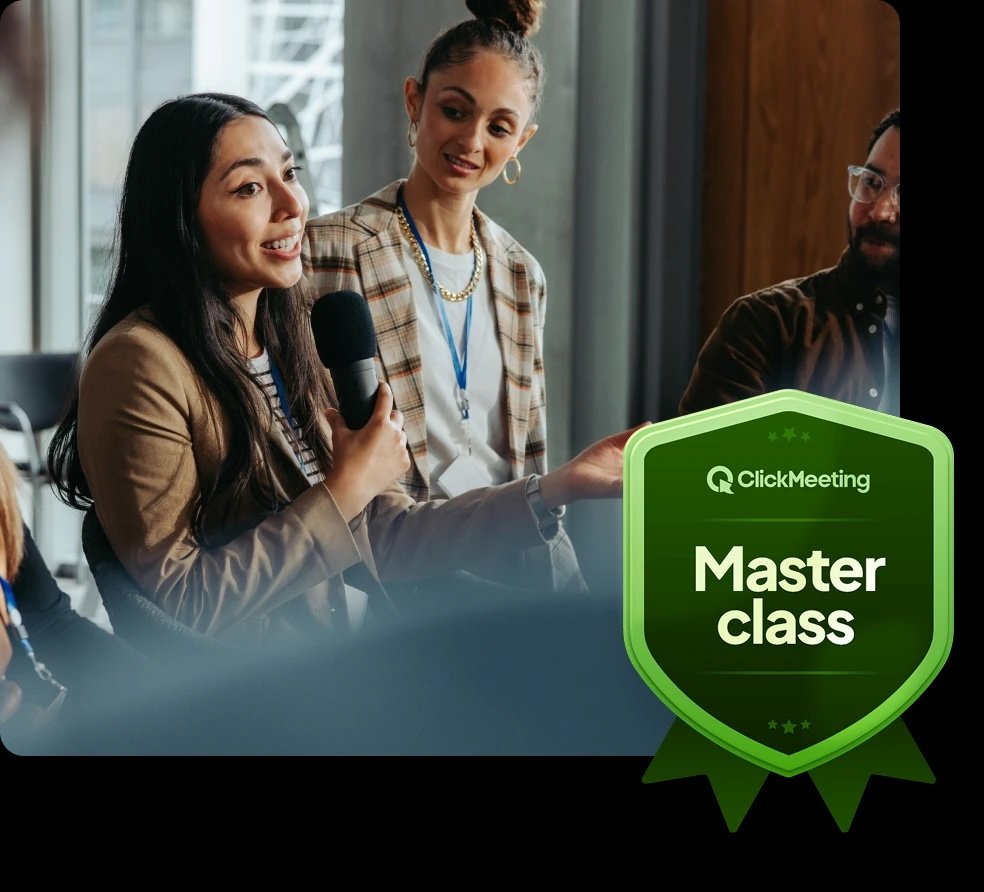
A masterclass earns money when you sell a specific outcome and deliver it through a predictable process: paid access, reminders, structured teaching, exercises, recording, materials, and a certificate. ClickMeeting helps you keep all of that in one flow—without manual link sending and without post-event chaos.
What is a masterclass and how is it different from a regular training session?
A masterclass ClickMeeting is a premium format. Narrow scope. High intensity. High expectations. People pay because they want a faster path to a result and live correction—something a typical webinar or a recording cannot fully replace.
What defines a masterclass:
- one primary problem and one measurable end result
- an agenda built as a path to implementation, not a topic list
- exercises, real outputs, and live corrections
- clear rules for recording, materials, and post-event access
- constraints: limited seats, limited time, defined entry level
How do you make money with a masterclass?
Revenue does not have to end with one ticket. Strong masterclass businesses layer income: live delivery as the core, premium options, and an on-demand “afterlife” that sells after the event.
Common revenue layers:
- tickets for the live edition
- a premium tier that adds real value
- recording sold as an on-demand product after the live session
- team packages for companies
- a masterclass series as a skill path
- a next step offer after the masterclass: implementation, mentoring, program
Why is ClickMeeting more than “just streaming” for a masterclass?
A masterclass is a product. Products need logistics: paid access, registration, communication, entry, delivery, recording, and post-event handling. ClickMeeting helps you run that logistics layer in one place so you do not rebuild the same process every time.
What ClickMeeting helps you standardize:
- paid access and controlled entry
- automated emails: confirmations and reminders
- delivery tools: presentation, screen sharing, interactive features
- workshop-style work in smaller groups via sub-rooms
- recording and structured post-event delivery
- certificates as a completion element that increases perceived value
How do you build a masterclass offer that sells?
A masterclass offer must be an outcome statement, not a feature description. Buyers want a changed state: from problem to solution. The sharper the outcome, the easier the price feels.
Offer components that improve conversion:
- the outcome in one sentence, written in practical language
- clear “who it’s for” and “who it’s not for”
- deliverables: templates, checklist, implementation plan
- live work: exercises and corrections, not only lecture
- rules for recording and materials access
- constraints: seat limit, schedule, scope boundaries
How do you write the offer step by step?
- Define the outcome as a sentence starting with “After this masterclass…”.
- Add three entry criteria: who will benefit and who will not.
- Build a 4–5 block agenda that leads to the result.
- List deliverables and post-event access rules.
- Set the seat limit and ticket tiers.
How do you design an agenda that actually delivers the outcome?
Winning is not about quantity of information. It is about sequencing the work. Participants must produce something during the session, not just listen.
A reliable agenda structure:
- block 1: diagnosis and quality criteria
- block 2: method and decision rules
- block 3: live exercise producing a real output
- block 4: corrections, mistakes, variants
- block 5: a 7–14 day implementation plan
How do you build the agenda step by step?
- Break the outcome into stages.
- Assign one exercise and one output to each stage.
- Reserve a corrections block based on common failure patterns.
- Close with a checklist and clear priorities.
How do you set up tickets and communication so attendance stays high?
Attendance drops less because the topic is weak and more because the process is unclear: no reminders, confusing entry instructions, scattered messages, missing “what happens next.”
Communication elements that must be tight:
- purchase confirmation with clear entry instructions
- a reminder 24 hours before start
- a reminder 1 hour before start
- basic technical requirements and participation rules
- a post-event message with materials, recording, and certificate
How do you launch the ticket + communication flow step by step?
- Configure tickets and access rules.
- Prepare the pre-event email set.
- Prepare the post-event package email.
- Test the flow as a participant: purchase → email → entry → participation.
How do you run the masterclass so pace and control stay intact?
The instructor should teach, not moderate chat and fight technical issues. A masterclass needs roles and rules.
Delivery practices that keep quality high:
- explain interaction rules in the first minutes: where questions go, when answers happen
- handle Q&A in blocks, not as constant interruption
- run exercises every 15–25 minutes to protect attention
- share a single window rather than the full desktop
- use a moderator when the group is not tiny
How do you execute the live session step by step?
- Open the room early and test audio/video.
- State rules: chat, questions, exercises, materials, recording policy.
- Deliver the method block, then run the exercise with a real output.
- Correct mistakes and show common anti-patterns.
- Close with an implementation plan and checklist.
- Send the post-event package exactly as promised.
How do you increase revenue per edition without damaging quality?
Extra revenue must come from extra value, not from aggressive selling mid-session. The product remains the outcome.
High-leverage revenue upgrades:
- premium tier with real instructor time (case review, follow-up clinic)
- on-demand recording packaged with templates and an execution checklist
- a series that turns one masterclass into a path
- a team edition for companies with dedicated Q&A or review
How do you reduce refunds and complaints?
Refunds come from mismatch or process failure. Premium formats need zero ambiguity.
What reduces refunds:
- a precise promise and strict scope boundaries
- an agenda that clearly matches the promise
- clear recording rules: if, who, and how long
- automated reminders and clear entry instructions
- fast post-event delivery of materials and access
Key definitions before you sell a masterclass
Masterclass
A premium, outcome-driven session designed to produce an implementable result in a short timeframe.
Ticketed access
Paid entry tied to registration and a defined scope of delivery.
On-demand
A packaged recording and assets delivered or sold after the live session.
Moderator
A role that keeps chat, questions, and rules under control so the instructor stays on track.
Implementation plan
A 7–14 day action sequence that turns the session into measurable execution.
FAQ
Can a masterclass earn money without a large audience?
Yes. A narrow outcome with high value can sell to a small, targeted group when the delivery process is clean and predictable.
Should you always provide a recording?
Not always. Provide it when it supports implementation or reduces “I can’t attend live” objections. Access rules must be clearly defined.
When does a premium tier make sense?
When it adds real value: case review, extra time, follow-up session, or priority corrections. If it is just a label, it reduces trust.
What matters most in the first edition?
A sharp outcome, a sequence-based agenda, and reliable post-event delivery. Everything else is optimization after the process is stable.
